
Friday, February 5, 2010
PHOTOS |
COMING SOON|
EXAMINER.COM FILM ARTICLES
||HOME
Friday, February 5, 2010
EDITORIAL RAMBLINGS
Actresses Under Cover Of Darkness:
Vanity Fair's Invisible
Woman (Of Color) Issue
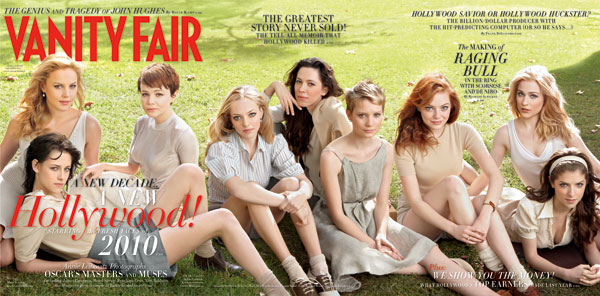
The March 2010 cover.
By Omar P.L. Moore/PopcornReel.com
 FOLLOW
TWEET
FOLLOW
TWEET
Friday, February 5, 2010
(*-includes grammatical correction)
America Ferrera,
Zoë Saldana, Naturi Naughton,
Danai
Gurira, Gabby Sidibe, Jennifer Hudson,
Shareeka Epps,
Raven Symone,
Beyonce,
Catalina Sandino Moreno,
Vanessa Hudgens.
All, except Ms. Saldana, are under 30.
On Vanity Fair's cover, can you see them now? (Um,
sorry,
Verizon.)
This week the Academy of
Motion Pictures Arts and Sciences gave three African-American actors
(Morgan Freeman, Mo'Nique and Miss Sidibe)
Oscar nominations.
Even my fuzzy old math
informs me that that's three more Oscar nominations than black people who adorn
Vanity Fair magazine's March 2010 cover.
(Interestingly, this month, Tiger Woods is on the
cover of the very same magazine, portrayed in a menacing fashion, very
tiger-like, doing his best "thug" outlaw impression. The
juxtaposition between the February and March covers is something worth thinking about.)
I'm not picking a fight with Vanity Fair. I've just been thinking about
this topic. A lot.
Timothy Greenfield-Sanders has
the latest installment of his wildly successful
"The Black List" series raring to go on
HBO this coming Monday night.
No doubt some, perhaps many (including
Muhammad Ali), may be tempted to say of the upcoming
"Black List": "if it's color you want without a fight,
then watch HBO on Monday night."
Each of the people in Mr. Greenfield-Sanders' 30-minute program on Monday are
successful,
high-profile African-Americans, speaking to former New York Times film critic
Elvis Mitchell about their work, families, experiences in a race-conscious
and racist society. To some, the insights may be shocking, especially from
supermodel Beverly Johnson (the first black woman to grace the cover of Vogue
Magazine.) To others, they won't be much of a surprise. The
first Black List installment, featuring such dignitaries and statesmen as
General Colin Powell, aired on HBO in 2008.
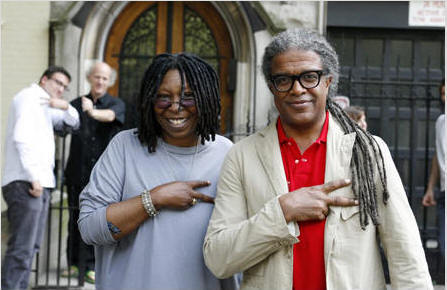
Whoopi Goldberg and Elvis Mitchell last year during
filming of The Black List Vol. 3, which
premieres on Monday night (Feb. 8) on HBO. Timothy Greenfield-Sanders
(black shirt, background)
directed the series. (Black List Project)
On an altogether different, though related note, it's worth observing that Oscar-nominated
director Jason Reitman found a talent like actress
Tamala Jones and cast her in
"Up In The Air". (She's dismissed by
Oscar nominee Anna Kendrick in the film.) Could Vanity Fair have placed
Ms. Jones on its cover?
(Maybe she was not as "it" an it-girl as it required.)
The well-known fact is this: editorial and management
decisions rule the day. The decision to cut staff, as many of the
journalism profession and elsewhere in America can attest, results in
bone-crushing impact, breaking hearts and morale, casting a pall of mistrust and
anxiety across newsrooms and water cooler hot-spots everywhere. A frosty
Darwinian draft cuts to the quick. And suddenly life on the presses of a
newspaper's domain is
nasty, brutish and oh so short.
The demographic making those decisions, as well as those about content, is often
just as critical.
Having said this, all the actresses on the March VF cover have
their place, and for their hard work and talent they merit sincere congratulations and acknowledgment.
Is there not however, a disconnect? America is more diverse in 2010.
Madison Avenue television ads (Levi's "forever young" campaign, etc.) promote
romantic engagements between members of different racial groups. It's a
new century, a new year, a new frontier. Demographics past and present
promise that women of
assorted racial backgrounds comprising what will in the not-too-distance future
be a majority of the U.S.A. Should there not be a diverse actress pool
pictured on Vanity Fair's cover to accommodate that inevitability? Or any
other magazine cover?
Isn't America diverse?
Is the lack of diversity reflected in American media Hollywood's fault? Vanity
Fair's? Either's?
Don't get me wrong: Vanity Fair can
--
and should -- put whomever it chooses on its covers. That is its unequivocal right.
In fact, the magazine isn't legally or maybe even morally obligated to put
any African-American,
Latina, Asian, Native American or Na'vi woman on its cover. Or anyone at
all on its cover, for that matter.
Similarly, none of the women of the aforementioned groups have
an obligation to buy the magazine if they don't want to.
In all of this of course, the specter of race and racism
inevitably
looms large. And nobody wants to discuss those indispensible
elephantine variables -- at least in mixed company. Any one who does is
either labeled a racist for bringing race up as a template for an honest and
(hopefully) civil discussion. Any one who complains is deemed a
trouble-maker, malcontent, "too sensitive" or "emotional".
Furthermore, anyone who makes a comment deemed offensive or potentially
polarizing treads on egg shells or fears the detonation of a landmine where
conversations on race are concerned. Will someone say something about
affirmative action? Will someone say that the fight for racial justice
ended with Dr. King and the human rights movement of the 1950s and 60s?
Will someone say: "you people"?
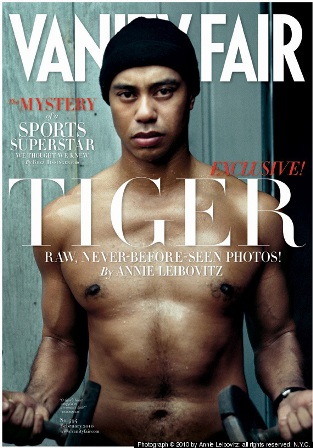
This month's cover of Vanity Fair. Photograph
©2010
by Annie Leibovitz. All Rights Reserved.
N.Y.C.
[Last November
Patrick Goldstein of the Los Angeles Times discussed
a story about Universal Pictures' European marketing campaign for the
deplorable film "Couples Retreat", which contained some of the worst racial
stereotyping of blacks (played by actors Kali Hawk and Faizon Love.) The
movie posters for the overseas campaign eliminated Ms. Hawk and Mr. Love from
view, leaving only the film's white performers (Jason Bateman, Malin Akerman, Kristen
Bell, Vince Vaughn, Jon Favreau and Kristin Davis.)
Confronted with this concern and many complaints, Universal later apologized but did not change its
marketing
course, adding that the DVD releases in the overseas markets would reflect all
principal cast members on the cover, namely those on its U.S. movie poster,
which includes Ms. Hawk and Mr. Love.]
* * *
On a personal note, actresses Rebecca Hall and
Amanda Seyfried are two very nice and candid
individuals with whom I recently participated in interviews. They and the
other seven actresses who populate next month's Vanity Fair cover should rightly achieve all
the success they legitimately can with their talents -- the cover issue situation is
not their fault, of course. All they are doing is trying to make an honest
living.
(Hypothetically speaking, had they refused to pose
for the VF cover with Gabby Sidibe and Jennifer Hudson
because they didn't like standing next to someone black for example, their
culpability stakes would be raised higher than a maximum gambling marker in
Vegas.)
This too must be mentioned: Vanity Fair's current online edition has a
fantastic slideshow photographed by Annie Leibovitz, which includes a
great picture of "Precious" director Lee Daniels, Mo'Nique and
Miss Sidibe.
* * *
Zoë Saldana, arguably the heart of
"Avatar" and a contributor to its
historic box-office success, was absent
from the March VF cover. She was also in "Star
Trek" last year; the first of those two 2009 films -- both of which made
well over $200 million in the U.S. and Canada -- and she was a notable figure
in J.J. Abrams' film. Should she not be on the VF cover? Isn't she an
"it" girl? An "it" woman? Isn't that for the country's demographic
of women and men to determine? And which demographic? Hollywood's?
The overall population's? Does an American Idol vote depend on it?
Doesn't Vanity Fair's editorial board ultimately decide that? Isn't
theirs* the only decision that counts?
Some will say that if you want to see Saldana, Hudson, and
co., peruse Ebony,
Jet,
Essence, Vibe, or get the clicker and
turn on BET, etc. True enough. One can and should pay those venues a
visit. And often. But is there a segregating principle that
inevitably comes with the notion that such venues are the only ones in which these
talented performers should be accessed? Is it an "integrating" principle?
(This also works in reverse: should black actresses always expect to adorn
Vanity Fair's cover? Should white actresses similarly expect to adorn
Jet's? Are these questions trivial? Must a mocking type of
"we-are-the-world" approach apply?)
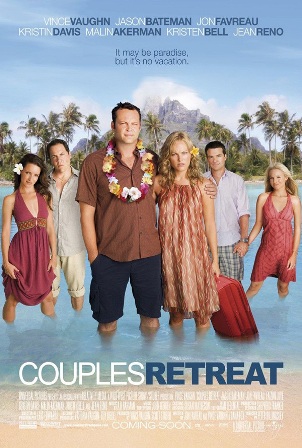
The U.K. poster of last October's movie release "Couples Retreat".
The poster's U.S. edition contains both its black actors, Faizon Love and Kali
Hawk. (Universal Pictures)
Let's take Jet. Jet, after all, has no obligation to put Miss Seyfried on
its cover. Miss Seyfried may not be Jet's demographic. (And vice
versa.) Would this similarly apply for Ms. Saldana,
Joy Bryant
or
Kerry Washington when the answer to the question of
demographics is attained? There is however, one additional truism: Vanity Fair, a popular
powerhouse, has the eyes and ears of the entire world upon it. And so does
O Magazine.
Perhaps the answer is that the premise of this internal monologue I'm having is
that all things of course, are not fair and equal on the
chessboard of race in America.
Speaking of America, actress America Ferrera was part of Vanity Fair's cover a
year or so ago, enjoying great success for "Ugly Betty".
Danai
Gurira
shined in the 2008 film "The Visitor" opposite
its Oscar
nominee Richard Jenkins. She has at least one film this year (recently at
Sundance) entitled "3 Backyards". She's arguably a star in the making.
Vanity Fair may not think of Ms. Gurira or Ms. Saldana as "it" girls.
Do they think of them as 'its'? Less-thans? "Not
economically viable"? (To coin a phrase from Joel Schumacher's 1993 film
"Falling Down".)
I don't know what the editors of Vanity Fair are thinking. It just wouldn't be fair to say.
Johnny Mathis once sang it: it's not for me to say. I'm serious.
Vanity Fair has its prerogative.
But on Vanity Fair's February cover, couldn't Tiger Woods have kept his shirt
on?
Kept his pants on?
(I think of Mr. Woods' look being a somewhat variable equivalent of Time Magazine's
"darkening" of O.J.'s face on its cover a decade-plus ago.) I wonder if
the late Marlon Riggs would have called that
"Color Adjustment"?
I'm just imagining: for the sake of argument, why wouldn't Gabby Sidibe sell
magazines or accentuate Vanity Fair's cover? Oscar nominee.
First-time film actor. Beautiful, charismatic, likable. Why not?
I can't help but opine on the March cover: isn't vanity fair enough?
PHOTOS |
COMING SOON|
EXAMINER.COM FILM ARTICLES
||HOME