The Popcorn Reel Celebrates Black History Month
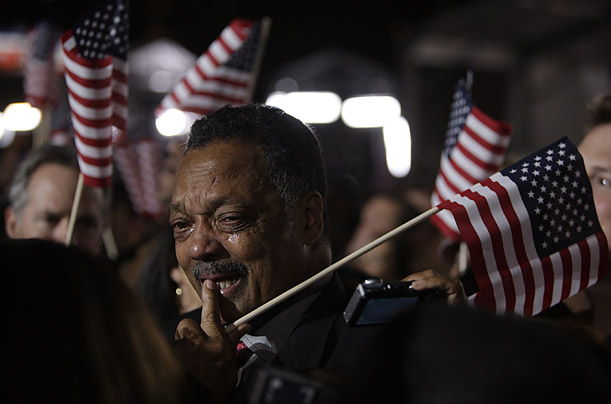
Jesse Jackson cries
in Chicago's Grant Park on the night of November 4, 2008 when news
of Barack Obama's victory for president broke.
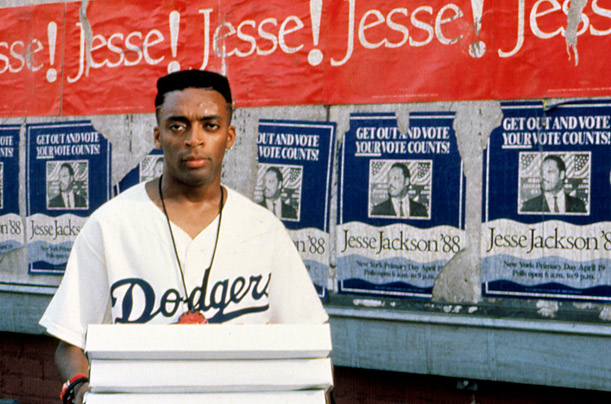
Top photo: Spike Lee as Mookie in "Do The Right Thing" - the parallels
of Mr. Jackson's presidential run in 1988 echoes in posters seen
behind Mr. Lee's character in his landmark 1989 film, whose 20th
anniversary arrives in June. (Top photo: Universal Pictures)
Obama Is The American President.
Time To
Pack Up And Stop Fighting For Justice?
By
Omar P.L. Moore/The Popcorn Reel
SHARE
February 1, 2009
"Hell No!", Mookie of "Do The Right Thing" would probably say to the
above question, and he wouldn't be alone.
President Barack Obama has been in office less than two weeks and so far
in the very early going most of America
is satisfied.
Does that mean that the battles are over, that fighters for social
equality and justice no longer need apply?
The continuing journey to justice and equanimity is always in transition
and America is making slow and
steady strides in the right direction and not without the blood, sweat
and tears shed to achieve it.
January 20, 2009 was more than a date. It was history. Some
would say it was a long time coming. Others would
say that nothing at all has changed. Police shootings of
innocent and unarmed black men don't take a break
to salute the nation's first and only black president, as many Oakland,
California residents can attest with the
gravely disturbing shooting death of Oscar Grant, 22, exactly one month
ago on a train station platform in
the early morning hours of the New Year.
Spike Lee's "Do The Right Thing" addressed police brutality in one
highly noted scene based on an amalgam of events
in New York City history in the 1980's, specifically the killing by
transit police of Michael Stewart, who had
apparently scribbled graffiti on a subway wall or train and paid for it
with his life, and the murders in Howard
Beach, Queens in 1988, when Michael Griffith was chased to his death by
a 20-plus member mob of white youths.
Mr. Lee's landmark film has its 20th year anniversary in June.
One of the most interesting (and hardly discussed) aspects of the film
is the support of leadership in the black
community that is divergent. The character of Da Mayor, played by
the late Ossie Davis, gives a visceral response
to Giancarlo Esposito's character Buggin' Out, who is organizing a
boycott of the Italian pizzeria in the black
neighborhood of Bedford-Stuyvesant.
"I don't wanna hear none of your damn black foolishness!", says Da
Mayor. Mr. Davis' character is in his sixties or
seventies; presumably a man who once fervently had a cause he believed
in, fought the good fight, then retired or
retreated to a corner to be left alone to get through each day of the
rest of his life. Maybe he embodies the
movement led by Dr. King; maybe not. Buggin' Out, by contrast, is
a young, passionate twenty-something who has
been aggrieved by the treatment by Sal (Danny Aiello), the owner of the
pizzeria. A man on a "revolutionary"
mission, Buggin' Out supports the Nelson Mandelas, Marcus Garveys and
Malcolm Xs of the world. Mookie falls,
it seems, somewhere between these two polar opposites.
Mr. Lee's Oscar-nominated film concludes with quotes from Dr. King and
Malcolm X, the latter of whom
he did an epic biopic on in 1992, with Denzel Washington in the title
Academy Award-nominated role.
President Obama also appears to stand between the worldviews of Buggin'
Out and Da Mayor -- at least he
illustrated this in his now-legendary speech "Toward A More Perfect
Union" during the presidential campaign
last March 18 in Philadelphia. In one segment of that speech he
said of his former pastor Reverend Wright
that
he could "no more disown him than I can my white grandmother -- a woman
who helped raise me, a woman who
sacrificed again and again for me, a woman who loves me as much as she
loves anything in this world, but a woman
who once confessed her fear of black men who passed by her on the
street, and who on more than one occasion has
uttered racial or ethnic stereotypes that made me cringe."
When President Obama as Candidate Obama said in the same speech that
"These people are a part of me. And they
are a part of America, this country that I love," he could have
been talking about the same array of
people that Spike Lee
populated "Do The Right Thing" with -- a complex, diverse mosaic, that
last word one that
former New York City Mayor David Dinkins used during his mayoral
campaign in 1989. Mr. Dinkins became
the first and only black mayor of the Big Apple in November of that
year. Mr. Davis's Da Mayor character
was thought by some to represent Mr. Dinkins in the film.
In "Do The Right Thing" when Mookie throws the garbage can through his employer's window he may
well
have been sounding the trumpet
that Reverend Wright did.
"Hate!", shouts Mookie.
Many whites who saw the film asked Mr. Lee, as he has often repeats in
interviews, "why does Mookie throw
the trashcan through the window?"
The director cites that no one
black has ever asked him that question.
To that end, there is a parallel in Candidate Obama's speech of last
March when he says that "[t]he fact that
so many people are surprised to hear that anger in some of Reverend
Wright's sermons simply reminds
us of the old truism that the most segregated hour in American life
occurs on Sunday morning. That anger is
not always productive; indeed, all too often it distracts attention from
solving real problems; it keeps us
from squarely facing our own complicity in our condition, and prevents
the African-American community
from forging the alliances it needs to bring about real change."
This portion of the-then future president's speech
also echoes Dr. King's words, replicated at the end of Mr. Lee's film,
that "an eye for an eye only leaves everybody
blind."
President Obama also added in his speech, "[b]ut the anger is real; it is powerful;
and to simply wish it away,
to condemn
it without understanding its roots, only serves to widen the chasm of
misunderstanding that
exists between
the races. " This portion sounds like the ever-evolving Malcolm X,
whom the new president
wrote about being
influenced by in his book Dreams From My Father.
At the same time in the speech from last March, Mr. Obama perhaps acknowledged
the sentiments of Sal, the
white
pizzeria owner in Mr. Lee's film, who during a tirade talks about
building his business "with my bare
fucking hands",
in a climactic encounter with his former worker. "In fact, a
similar anger exists within
segments of the white
community. Most working-and middle-class white Americans don't
feel that they
have been particularly
privileged by their race. Their experience is the immigrant
experience - as far
as they're concerned, no
one's handed them anything, they've built it from scratch. They've
worked hard
all their lives, many
times only to see their jobs shipped overseas or their pension dumped
after a
lifetime of labor. The fact
is that the comments that have been made and the issues that have
surfaced
over the last few weeks
reflect the complexities of race in this country that we've never really
worked
through - a part of our union
that we have yet to perfect."
As new leadership is ushered in to America's highest office, parallels of Mr. Lee's film
are strongly reflected
in the
subtext of real black poltical leadership. Posters for Jesse Jackson's 1988
presidential run (the year
during
which the film was shot in Brooklyn) adorn several scenes in "Do The
Right Thing". Mr. Jackson, a
close King lieutenant, made headlines last year for several off-color
statements about Mr. Obama
during an appearance on Fox News Sunday. Later in the year Mr. Lee
was an active recruiter of voters
in Florida, for then-Senator Barack Obama's campaign. Mr. Obama
has hailed Mr. Lee's "Do The Right Thing",
in which John Turturro's Pino character lists several black leaders
including Reverend Al Sharpton and
Minister Louis Farrakhan.
After more than 20 years Mr. Lee has remained a vibrant storyteller, his
striking visuals a powerful motif and
commentary on race and racism in America, which is also exemplified in
his latest feature film "Miracle At
St. Anna" (which arrives on DVD in the U.S. and Canada on February 10).
This year will also be the 30th
anniversary of 40 Acres And A Mule Filmworks, Mr. Lee's production
company. Mr. Lee has become
one of preeminent deans of American cinema in this early 21st century,
cementing his legacy with films
that endure, instruct, edify and entertain. You can always be sure
of thought-provoking themes, particularly
in the little-seen "Bamboozled", the award-winning documentary "When The
Levees Broke" and the
immensely powerful documentary "4 Little Girls". The second film
was an indictment of the prior occupant
of the White House, an example of film and politics intertwined.
("She Hate Me" took on George W. Bush
in a satirical way in 2004.)
In the March 18 speech then-Senator Obama said: "As William Faulkner
once wrote, 'The past isn't dead
and buried. In fact, it isn't even past.' We do not need to
recite here the history of racial injustice in this
country. But we do need to remind ourselves that so many of the
disparities that exist in the
African-American community today can be directly
traced to inequalities passed on from an
earlier
generation
that suffered under the brutal legacy of slavery
and Jim Crow."
The answer to the question titling this article is spoken often by
"Silence Of The Lambs" and "Rachel
Getting Married" filmmaker Jonathan Demme: a luta continua.
SHARE
Copyright The Popcorn Reel. PopcornReel.com. All Rights
Reserved.