


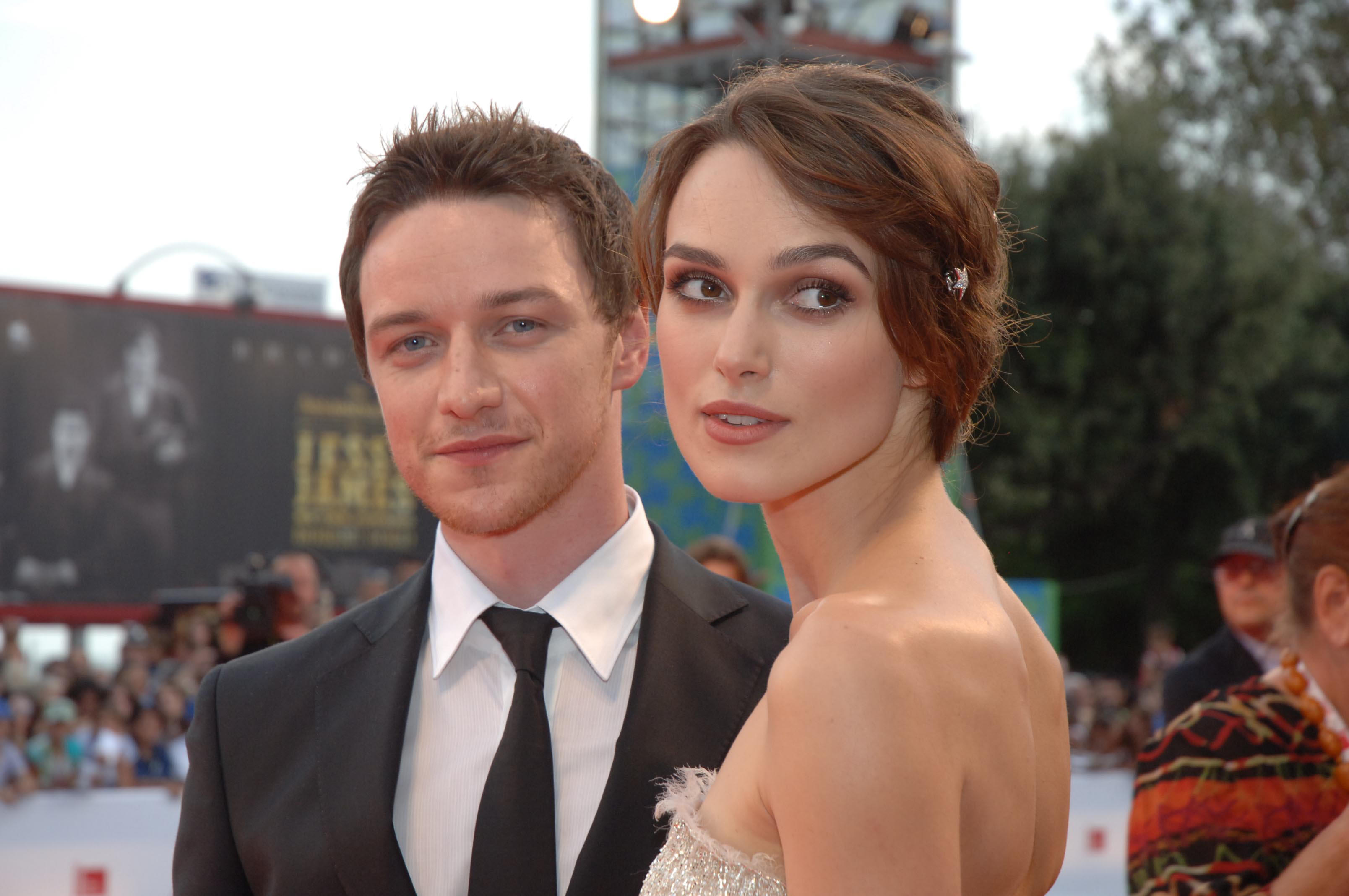
August 29, 2007 -- A day in the life of James McAvoy: At the 64th Venice
Film Festival with "Atonement" co-star Keira Knightley. "Atonement",
director Joe Wright's second film, opens in San Francisco, New York and Los
Angeles on December 7 and other U.S. cities in the following week.


printer-friendly
 ames
McAvoy cites a definitive difference between Los Angeles and San Francisco:
"Whenever I land in L.A. I don't feel like I'm coming to America, I feel
like I'm just coming to work. But I land in San Francisco, and I go,
'hey great, U.S.A. man, excellent, I feel like a tourist!' It was a
nice difference, you know?" With apologies to the City of Angels
aside, the Glasgow-born thespian loves this city, and this was his first
trip here.
ames
McAvoy cites a definitive difference between Los Angeles and San Francisco:
"Whenever I land in L.A. I don't feel like I'm coming to America, I feel
like I'm just coming to work. But I land in San Francisco, and I go,
'hey great, U.S.A. man, excellent, I feel like a tourist!' It was a
nice difference, you know?" With apologies to the City of Angels
aside, the Glasgow-born thespian loves this city, and this was his first
trip here.
All work and no play makes Jack a dull boy, and for James McAvoy there has
been plenty of work on the big screen in the last two years, as well as some
time to be his working-class self, for those are his roots, and he's
definitely sticking to them. He comments before a small group of Bay Area
journalists assembled at a suite inside a local hotel that while he leads a
charmed middle-class life these days as a fast-rising actor, he loves to
hold on to the things in his life that have made him who he is. Asked what
makes him who he is, he lists hobbies that include hiking and playing
football (that's soccer to those in the United States) and slips in an FYI
for the ladies: he likes to cook. (And he does the dishes, to
boot.) He confesses that for a fleeting moment he wanted to be a priest,
"and then I found women, and I realized that I didn't want to sell my
sexuality to the Catholic Church." He says that if he hadn't gone to drama
school he would have joined the Navy. McAvoy graduated from drama
school "at about 20." The biggest transition in his life he says, was
moving from Scotland to London, and while he seemed hesitant during this
late November morning interaction to cash in his chips and move to Los
Angeles, he is anything but hesitant to talk about "Atonement", the new film
he stars in, released by Focus Features and opening very soon in the U.S.
and Canada.
Mr. McAvoy, 28, is attired in a jacket and narrow black tie, with jeans.
A lean and sturdy presence, he speaks in low tones and is about as casual in
his speech and as down to earth as an actor who has been on a hot streak in
Hollywood can be. He will say that he has been very fortunate
career-wise, as the ball has bounced very kindly for him. With all of
the good things that have come his way of late he remains grounded, focused
and thankful. Of acting McAvoy says: "It's an incredible job. I'm
very, very lucky." He also provided a frame of reference applying
threads of his own life to aid in constructing Robbie Turner, the character
he plays in "Atonement". "The life I lead right now is very kind of elite
-- I live in a world that not a lot of people get a glimpse of, let alone
get into, and that's a similar environment that Robbie is in."
Joe Wright, who directed "Pride & Prejudice", the only celluloid feature
on his resume prior to this new film, put Mr. McAvoy through his paces.
"It was tough," Mr. McAvoy said of the character Robbie, in "Atonement", "to
play someone who wasn't conflicted or real."
The award-winning book "Atonement" is real however, and Ian McEwan wrote
it. The story about a young girl named Briony Tallis, who tells a story
involving Robbie and his love Cecilia (played by Keira Knightley), a story
giving Robbie an unenviable choice in his life, riveted the actor and after
reading the script that Christopher Hampton adapted from the book, Mr.
McAvoy made up his mind that there was only one way to play Robbie, and that
was as he was depicted. Audiences will see this portrayal in select
U.S. and Canada theaters beginning on December 7 before Mr. Wright's
sophomore feature film effort expands to more cities across North America in
the following weeks. "Atonement" received a lot of plaudits at Cannes
and Venice earlier this year, and it is already been generating critical
buzz this awards season. Mr. McAvoy's performance is expected to get
significant attention amidst the awards hoopla over the next two or three
months for his work as Robbie, a working-class educated man in pre-World War
Two England who gets caught up in a web of predicaments. "When I read
the script I thought it was the most beautifully crafted thing I'd ever
read, in terms of screenplays," Mr. McAvoy explained. "Atonement" also
features Brenda Blethyn ("Introducing The Dwights") and Saoirse Ronan.
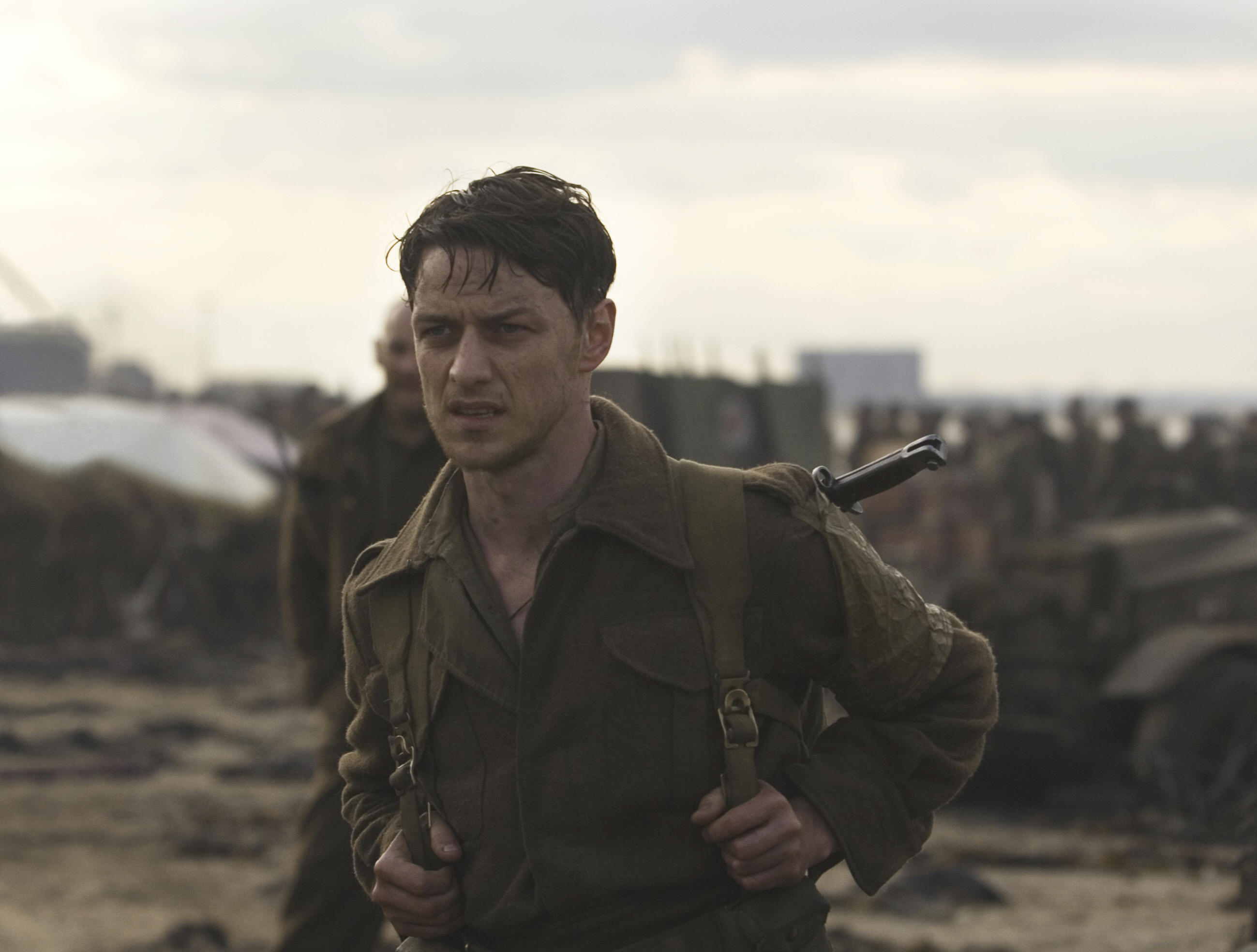 James McAvoy as Robbie in "Atonement". Of his life off the big
screen, the Scottish-born McAvoy says, "I'm fucking dull, man. I adhere to the stereotype of a Scotsman.
I have a
very tight wallet. I keep it closed." (Photo: Alex Bailey/Focus
Features)
James McAvoy as Robbie in "Atonement". Of his life off the big
screen, the Scottish-born McAvoy says, "I'm fucking dull, man. I adhere to the stereotype of a Scotsman.
I have a
very tight wallet. I keep it closed." (Photo: Alex Bailey/Focus
Features)
For his role in Mr. Wright's film McAvoy didn't need to undergo much
military training; he half-jokingly says that he knows what a soldier has to
do. He did more reading and watching of films like the classic David Lean
movie "Brief Encounter" (he mimics a flawless English accent of the film's
actor Trevor Howard) and British war documentaries like "Listen To Britain",
which he described as a jingoistic piece, to prepare for his role than
anything else, but of his most important interaction, a moving experience
with one of the World War Two British veterans he spoke to who told him that
"'when you're making this film, just know how terrible it really was,'" Mr.
McAvoy recalled. "Being there for that I think imparted a sort of emotional
truth that I didn't get from any amount of documentation or first-person
accounts, either. It was incredible, really," he added, citing the
importance of all of the sources he pulled from to make Robbie work within
the scope of Joe Wright's epic canvas. He acknowledged that he didn't
know why he kept being cast in period films, but was glad to have the work.
Mr. McAvoy also said that an actor had greater latitude when cultivating a
period of time rather than the present day. "Evoking and capturing the
spirit of a time . . . it's a little bit more artistically expressive." As
he spends a few minutes discussing the contrast in audiences views of
contemporary versus historical pieces, providing examples of science-fiction
films and the like, he mentions that at the end of the day "truth is just
perception, isn't it?", and then says a few other things, adding, "I don't
know what I'm talking about."
Though he may have just experienced this
moment of je ne sais quoi, James McAvoy's acting has been talking very
clearly. He has played roles that have required inner conflict rather
than external crisis in such films as "The Last King of Scotland" and
"Becoming Jane" (the latter was released late this past summer in the U.S.)
and "Atonement" was an opportunity that he couldn't pass up, even if he
still had to convince others in auditions that he was worthy of the role,
and even if it meant that he would inhabit a character that would go against
the DNA of characters he has played in the past. He agreed with one
journalist's assessment that in using acting styles of the 1930's he had to
flex a different muscle with Robbie. "I found [Robbie] ... wasn't
particularly representative of the human race because he's so good. I
mean, he has so little conflict in him and I really didn't recognize him as
a member of the human race to begin with, and I think that that's fair to
say because he is a slightly idealized human figure, and it's necessary
really because the story's a tragedy," notes the star of such films as
"Starter For Ten", a more light-hearted film for McAvoy, who in 2006 was the
inaugural recipient of the Orange Rising Star Award at the British Academy
of Film and Television Awards.
The actor acknowledged that he was worried about how his portrayal of
Robbie would play out, especially for the first half of Mr. Wright's film,
and he would later offer a cautionary piece of advice, saying that as an
actor when you are in the moment "you have to be aware at the same time that
you might just be going too far because you like going far, do you know what
I mean? So you just have to take yourself back a wee bit."
Especially when characters in a period drama like "Atonement" are not, as
Mr. McAvoy would say, "actively expressive", in light of the era of a
repressive and staid British society of the 1930's and '40's. McAvoy
is not a method actor, though he did employ some preparatory techniques to
help mold him into the character of Robbie. "A lot of the other actors
in the film are from an upper-class background, and I'm not, and I don't
have a problem with that," he said, but when it came to eating dinner during
breaks in filming each night with the cast and crew Mr. McAvoy decided "that
it would be useful to kind of keep myself separate," electing to join the
rest of the actors and crew up at a house for dinner only once or twice a
week. "I could have been up there every night having dinner if I
wanted, but -- and the invitation was always there for me to go -- but in my
head I kind of, I tried to slightly just pretend that I was going up when I
was invited up, that I was there at their convenience. And that really
helped a lot . . . because the character (of Robbie) is so terrifying to the
classes above him. He's not somebody who makes them comfortable about
the way the world is. He bucks a trend. He represents the
emancipation of working classes, the emancipation -- fucking -- of women and
their burgeoning freedom in the workplace . . . he represents that, but he's
ten years too early." (Lest there be any confusion, this journalist is
of the mind that McAvoy uses the word "fucking" as an adverb or adjective,
and in an awe-struck or incredulous sense, and not literally, when he speaks
about women.)

"I've no idea of why I keep getting cast in period things, but I enjoy
it," says James McAvoy, shown here at last summer's 64th Venice
International Film Festival. (Photo courtesy: WireImage)
In "Atonement" there is psychology and physicality, as well as innocent
victims, innocence shattered and innocent malfeasance of the adulterated
kind, but above all, as the movie's tag line hints and lead star agrees,
"Atonement" is "a film about storytelling". The film is set in late 1930's
London and spans about 20 years and later revisits several characters. No
matter whether awards are feted upon it "Atonement" will be remembered and
celebrated for an unbroken tracking camera shot that lasts all of four
minutes or so, and McAvoy says that this shot was the biggest challenge.
"The stakes were really high -- we had one day to shoot it and we only did
three and a half takes because we had to rehearse the entire day and it was
such a logistical nightmare." The emotional effects of this shot paid
off however, as McAvoy mentioned the tearful reaction from many crew
members, at least 100 in number, with whom he had watched the scene with
during the production.
Mr. McAvoy is later prompted to answer whether he
thinks "Atonement" will play differently in America as opposed to England,
where issues of class are concerned. (As of the date of this writing,
the film has been playing in theaters in England for about 12 weeks now.) I don't think that the class system in Britain exists now the way that it did
then in this film. I think it still does exist. Every time I think that it's
completely been abolished I meet somebody who reminds me firmly that I'm --
fucking -- even though I have a middle class and kind of jet-set lifestyle --
[that] I'm
still from the working class. But I think what the difference is is that we're
(meaning the British) fascinated by it . . . I think Americans are less
fascinated by class and maybe more fascinated by money. And largely they're the
same fucking thing -- but not quite -- there are slight differences."
Within three months after "Atonement" hits American cinemas, James McAvoy
will be back on the big screen in North America in "Wanted", an
action-thriller starring Angelina Jolie and Morgan Freeman. He says he
hasn't seen it yet, but hopes that it will be good once he does. When
the cameras and the lights have been turned off, Mr. McAvoy says he is
content to retreat to the comforts of home, in the tradition of his
sedentary grandparents. He will "do the monkey dance" and promote the
heck out of any new film release he figures in, but declares that if movie
posters for his subsequent films are hung up on billboards adorning the
streets and he is toasting his success, "I won't be driving past swigging
whiskey one minute after I need to."
"Atonement" opens in select U.S. and Canadian cities on December 7.
