MOVIE REVIEWS |
INTERVIEWS |
YOUTUBE |
NEWS
|
EDITORIALS | EVENTS |
AUDIO |
ESSAYS |
ARCHIVES |
CONTACT
|
PHOTOS |
COMING SOON|
EXAMINER.COM FILM ARTICLES
||HOME

Saturday, March 3, 2012
REMEMBERING
Stanley Kubrick: The Films Of Tension, Irony,
Power
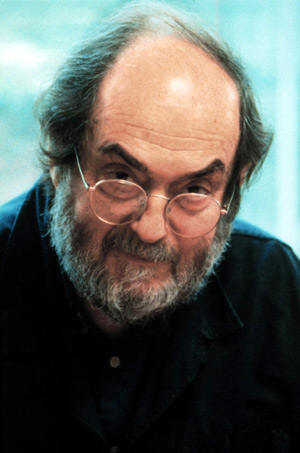
Stanley Kubrick.
Warner Brothers/Christiane Kubrick
by
Omar P.L. Moore/PopcornReel.com
 FOLLOW
Saturday,
March 3, 2012
Wednesday March 7 will mark the 13th
anniversary of the passing of filmmaking legend Stanley Kubrick. He passed
away in 1999 in his sleep, apparently from natural causes. He was only 70,
and hadn't seen the final cut of what would be his last film,
"Eyes Wide
Shut", a grand triumph of power, dreams and love-sex mind games.
Thirteen is a number that Mr. Kubrick perhaps had a fascination with or at least
a curiosity about. "Eyes Wide Shut" was his thirteenth film, although he
disowned "Spartacus", which was reshaped and credited completely away from Mr.
Kubrick and the vision the Bronx, New York-born director had for it.
There's a door with the number 265 on it in "Eyes Wide Shut". The height
of the maze hedge in "The Shining" is 13 feet. Prior to his debut feature
"Fear And Desire", a thirteen-letter title, Mr. Kubrick made a short film
entitled "Day Of The Fight", which also contains thirteen letters, as does the
English county of Hertfordshire, where the filmmaker and his wife Christiane
lived for most of the second half of Mr. Kubrick's life. These repetitions
of the number 13 may be simple coincidences in the director's life but some have
argued that such numerological consistencies are not an accident.
Mr. Kubrick, an avid teenage photographer at Look Magazine in the 1940s, first
burst onto the feature film scene with "Fear And Desire". He went on to
direct other films whose titles contained contradictory aspects or tensions:
"Eyes Wide Shut", "A Clockwork Orange", "Dr. Strangelove", among others.
Endless tensions erupt in Mr. Kubrick's work, whether in the infamous "Singin'
In The Rain" sequence in "A Clockwork Orange", when Malcolm McDowell savagely
beats a victim he sets upon, or in "2001", where the expiration of HAL 9000, a
cold, conniving computer is a tender affectionate sign-off with the sing-song
"Daisy, Daisy", or in the ironies and skewering of war in the films "Dr.
Strangelove", "Full Metal Jacket" and "Paths Of Glory". There's also the
tension between spousal love commitment and extramarital sex in "Eyes Wide
Shut", most notably in the color scheme: red for warmth/danger, blue for cold
comfort. The primary colors red and blue constantly clash, appearing in
every scene of the 159-minute film.
Known for his excessive number of takes for scenes, sometimes more than 200 or
300, Mr. Kubrick shot footage of immense length for "The Shining" and spent
three years in production on "Eyes Wide Shut", which led Tom Cruise to forgo
offers of work in other films. The director's final film, released in the
U.S. and Canada on July 16, 1999, invites endless speculation. Was Mr.
Kubrick in one of the film's scenes at the Cafe Sonata night club when Mr.
Cruise's Bill Harford character walks in to see Nick Nightingale (Todd Field)
perform a piano set? Or was it simply a look-alike?
I've always believed that though Mr. Kubrick saw the world and the humanity that
rules it with a cold, harsh, pessimistic lens in many of his films (and was
viewed as a misogynist in his film representations of women, something few
observers deny in private), I see him as a warm-hearted, sensitive romantic.
Beneath the stark, brittle visions of humankind there's warmth and romanticism,
whether in the fanciful, mocking fervor of "Dr. Strangelove", the elegance of
"Barry Lyndon", the emotion of "Paths Of Glory", which features a moving,
heartfelt song sung by Christiane Kubrick, Mr. Kubrick's then-girlfriend, or in
the sweet, endearing aspects of "Eyes Wide Shut", namely the interplay between
then-spouses Ms. Kidman and Mr. Cruise near the end of the film.
Who can forget "2001: A Space Odyssey", where the contrast between the bright,
shrill, frenzied ape activity and the sudden amazing edit of a space capsule
module, calmly drifting in the cool darkness of outer space? (Seeing this
edit of one image to the next in a darkened theater on the big screen does
something to the pit of your stomach that I can't even describe.)
Stanley Kubrick was a family man. With three daughters and his wife, he
believed in the strength of family. He had been with Christiane for more
than 50 years before his untimely death. One of the most ironic signatures
in his films was in "Eyes Wide Shut", when Mr. Cruise says "fidelio" (faithful)
as a password to gain admittance to a mansion orgy where sex is sex and
commitment and fidelity fly out of the mansion windows. Mr. Kubrick also
cheekily and crudely interrupts the notion of family in the same film when Ms.
Kidman and her onscreen daughter Madison Eginton are doing mathematics homework
around a dining room table and Mr. Cruise replays his wife's account of the
dream that Ms. Kidman's Alice told him, while he looks at her. We hear her
voice as she talks about the many men she slept with in her dream as we see her
grinning face. It's a powerful moment but also a comedic one.
Mr. Kubrick had a sense of humor that by many accounts was wicked and acute.
Often his film characters would say things that would result in big laughs or
knowing snickers. I've long adored "2001: A Space Odyssey" and thought
highly of "The Killing", a stunning film I think is an underrated gem. The
screenplay is wound tight, and the actors who populate this riveting drama,
including the great Sterling Hayden, who would later appear in "2001", are
first-rate.
Stanley Kubrick had a way of penetrating your imagination so deeply as to
unsettle you. I distinctly remember the intensity of "A Clockwork Orange",
especially the sequence in which Alex, his held eyes wide open, is strapped to a
chair and millions of images are bombarded into him. The director makes
the point about violence and makes it well. The images of his films,
whether of Ms. Kubrick in "Paths Of Glory", or of Vincent D'Onofrio in "Full
Metal Jacket", or of Jack Nicholson in "The Shining", or of James Mason in
"Lolita", or of actors in scenes in other Kubrick movies -- shake you and stay
with you.
And Stanley Kubrick stays with us. His artistry was, and is compelling.

Nicole Kidman as Alice in "Eyes Wide
Shut", Stanley Kubrick's final film. Warner
Brothers
COPYRIGHT 2012. POPCORNREEL.COM. ALL RIGHTS RESERVED.
FOLLOW
MOVIE REVIEWS |
INTERVIEWS |
YOUTUBE |
NEWS
|
EDITORIALS | EVENTS |
AUDIO |
ESSAYS |
ARCHIVES |
CONTACT
| PHOTOS |
COMING SOON|
EXAMINER.COM FILM ARTICLES
||HOME