MOVIE REVIEWS |
INTERVIEWS |
YOUTUBE |
NEWS
|
EDITORIALS | EVENTS |
AUDIO |
ESSAYS |
ARCHIVES |
CONTACT
|
PHOTOS |
COMING SOON|
EXAMINER.COM FILM ARTICLES
||HOME

.jpg)
Saturday, November 17, 2018
MOVIE REVIEW/Widows
Disrupting The Body Politic In Chicago
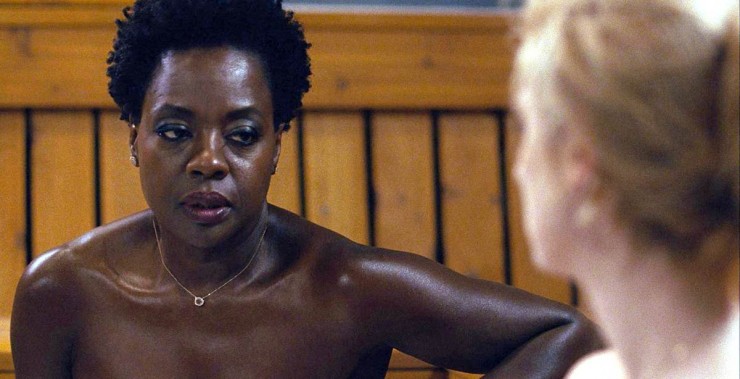
Viola Davis as Veronica in Steve McQueen's "Widows", which opened yesterday in
the U.S. and Canada.
Fox
by
Omar P.L. Moore/PopcornReel.com
 FOLLOW
Saturday,
November 17,
2018
Arresting and fascinating -- two verbs to describe Steve McQueen's "Widows", one
of the year's best films. Mr. McQueen opens his glossy, blue-green-hued
minimalist heist drama with a stark, peaceful image: a Black woman (Viola Davis)
and a white man (Liam Neeson) kissing tenderly in bed against white linen
sheets. Mr. McQueen intersperses flashbacks of Veronica (Ms. Davis) and
Harry (Mr. Neeson) and their married life together. They experience
tragedy in Chicago, the perfect backdrop for Mr. McQueen's latest examination of
anatomy, this time of a corrupt, treacherous political system controlled and
dominated by (gangs of) white men, and women's (and everyone else's) survival in
it.
Veronica and two other women (played by Michelle Rodriguez and Elizabeth
Debicki) it turns out, have been widowed owing to a botched heist by their
husbands in which two million dollars burned in a fire. The money belonged
to African-American Jamal Manning, who is running for alderman of Chicago's 18th
ward (Brian Tyree Henry) against the Windy City political machine hierarchy
white family Mulligan, led by its latest iteration in Jack Mulligan (Colin
Farrell) and authored by his racist father (Robert Duvall). Think: Richard
J. Daley, whom Mr. Duvall's character resembles, and not by accident. The
machinations of the Mulligans are more of the Boss Tweed variety, however.
Oh, about those missing millions? The three widows have one month to repay
the money, Manning's violent henchman (Daniel Kaluuya of
"Get Out" and
"Black Panther")
warns.
Sharply written with great dialogue by author Gillian Flynn ("Gone
Girl") and Mr. McQueen, the densely-layered and mathematical "Widows"
(also based on the mid- 1980s British television series by Lynda La Plante) is
about many things: the cruel reality of the American Dream for the powerless,
the exploitation of that Dream by the powerful, and distinct, discrete families
trying to gain a foothold amidst it all.
There's a boldness, ruthlessness and irony about what we see in "Widows": Joe
Walker's calm, discreet and marvelous editing belies the chaotic, vigorous,
boiling and violent (in many dimensions) events that transpire. The rich,
saturated visions by cinematographer Sean Bobbitt only emphasizes that the
incidents on screen are more insidious and sickly.
Mr. McQueen and his team brilliantly tell the story of a lie that wounds so many
actors, almost all of whom cannot possibly be said to be bad gals or bad guys.
It's the system itself that produces these actors because it's the system, Mr.
McQueen appears to argue, that is its own biggest enemy and cyclical problem.
Structures prop up a fragile, weak minority by assaulting and preying upon the
vast majority held captive (or heisted) in that structure. "Widows"
mandates that corrective measures are required. "Widows" is like an
extended political campaign ad about America, and I write those words with
earnest seriousness.
The cynicism of the system, a system which plays out to devastating effect in
many scenes, infects both Veronica, a devoted, prinicpled and hard-nosed
pragmatist and Jack, a contemptuous, deceitful man who holds pantomimed campaign
events to feature initiatives by Black women business owners in Chicago.
One of numerous excellent scenes features Jack (who himself wants a defeat of
the white male powers in Chicago) expressing what he really feels while his wife
whips him into shape. It's a classic enabling of the landscape of power,
done in Shakespearean Lady Macbeth style, most notably by a party whose gender
has been squashed and oppressed by that powerful system. Some of the women
in "Widows" are enablers and entrenchers of the patriarchy but even their love
(some of it familial) is never less than well-intentioned.
The brilliantly acted "Widows" is also about men and women and the gendered
roles they occupy in a patriarchy and Mr. McQueen (a Black man) and Ms. Flynn (a
white woman) reorder that dynamic here so very well and thoroughly.
"Because they don't think we have the balls to pull this off!", one character
says to her sisterhood, in one of the film's very best lines. (Another
line, "I had to save me!", is a metaphorical line aswell as a plaintive
one.) It is refreshing to see women in a Tinseltown film having the kinds
of truthful, complete, in-depth conversations about their aspirations, fears,
hopes, dreams and goals -- but even more, it is greater to see the proactive
ways in which this embattled sisterhood operates. Hans Zimmer's
percolating score ups the ante and augments the mission that these women, joined
by a babysitter (Cynthia Erivo), whose lack of job choices and options pushes
her to quickly accept a key role in the heist.
In her best big screen performance Ms. Davis excellently commands, caresses and
controls Veronica as a superbly dimensional leader, lover, mother, plotter,
architect and most clearly and obviously a Black woman, a dark-skinned Black
woman at that -- a rarity at all in Hollywood film, as a thinker, doer, emoter,
investigator, feeler and actor. Veronica has an anthem, so by extension
does Ms. Davis. Nina Simone's "Wild Is The Wind" is that anthem, as
precious, precise and yearning as any for a character in recent film memory.
The song crystalizes Veronica, but the director seems to reach deeper here to
Ms. Davis herself, and her infectious, warm persona and the impactful awards
speeches she has given. Viola Davis deserves the Oscar for her work in
"Widows", in an excellent career-making performance. There's one scene in
"Widows" that shows you why Oscar is coming to Ms. Davis in 2019. (You
will, I believe, instantly know which scene it is.)
One thing I asked myself after seeing this fine ensemble film: are the players
on this wonderfully nuanced (and sometimes not) chessboard bad? I don't
think so. The external pressures of a system have pushed them to make
choices and react to the stench of what they are living in. Mr. McQueen,
more dimensional and restrained in his direction in his most "conventional" but
best effort, shows us a final image that is as clever as his opening one.
One character might be talking to the wind, the system, to us, or all of the
above.
"Widows", Chicago, Mr. McQueen and Ms. Flynn are a perfect match: it's not the
excellent architecture of the buildings that count here, it's the even better
architecture and anthropology of the system and the people in it that do.
With: Jacki Weaver, Carrie Coon (who I didn't even remember who she played in
the film!)
"Widows" is rated R by the Motion Picture Association Of America for violence,
language throughout, and some sexual content/nudity.
The film's running time is two hours and nine minutes.
COPYRIGHT 2018. POPCORNREEL.COM. ALL RIGHTS RESERVED.
FOLLOW
MOVIE REVIEWS |
INTERVIEWS |
YOUTUBE |
NEWS
|
EDITORIALS | EVENTS |
AUDIO |
ESSAYS |
ARCHIVES |
CONTACT
| PHOTOS |
COMING SOON|
EXAMINER.COM FILM ARTICLES
||HOME